
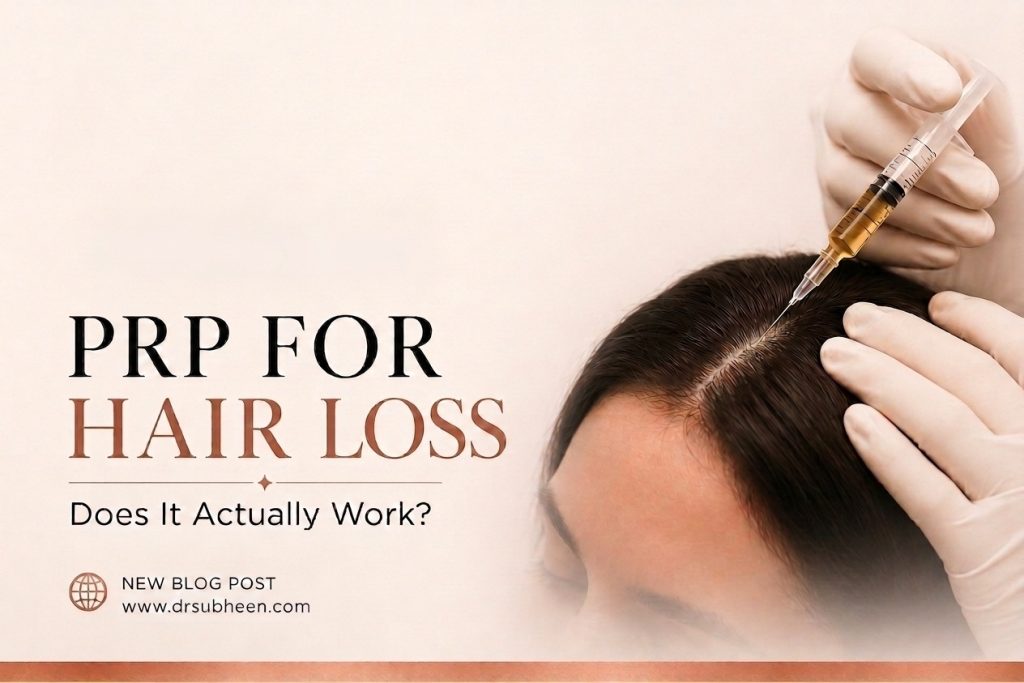
PRP for Hair Loss: Does It Actually Work?
“I’ve tried everything” is one of the most common things patients say before we even start talking about PRP. Serums, supplements, oils, a dozen different shampoos and still, more hair on the pillow than they’d like. If that sounds familiar, PRP is worth understanding properly, because the honest answer to “does it work” is more nuanced than yes or no.
What PRP actually is
PRP stands for Platelet-Rich Plasma. It’s drawn from your own blood a small sample is spun in a centrifuge to separate and concentrate the platelets, which are then injected into the scalp at the level of the hair follicles.
Platelets carry growth factors your body already uses to repair tissue. Concentrated and delivered directly where hair growth has slowed, they help wake up follicles that are still alive but underactive not regrow follicles that have already died out completely. That distinction matters more than almost anything else in this conversation.
Why it helps and where it stops helping
Hair thinning usually isn’t an all-or-nothing event. Follicles miniaturize gradually, producing finer, shorter hairs before they stop producing hair altogether. PRP works best in that in-between window, where follicles are struggling but not gone.
That’s why timing changes everything. Someone with early thinning and a visibly reduced hair density tends to respond well. Someone with a long-bald patch of scalp, where follicles have been inactive for years, is unlikely to see the same result because there’s nothing left there to stimulate.
This is also why PRP is rarely used alone in a well built treatment plan. It’s commonly paired with PDRN, topical minoxidil, or an oral treatment depending on the underlying cause, since hair loss is often driven by more than one factor at once genetics, hormones, stress, iron levels, thyroid function. Addressing only the scalp while ignoring the cause behind it tends to produce underwhelming results, PRP or otherwise.
What a session actually looks like
- A small blood sample is drawn, just like a routine blood test.
- It’s processed in a centrifuge to isolate the platelet-rich layer.
- The scalp is numbed, then the PRP is injected across the areas of thinning.
- The whole appointment typically takes 30–45 minutes, with little to no downtime — mild redness or tenderness at the injection sites is normal for a day or two.
Timeline and realistic expectations
This is the part patients are least prepared for: PRP is not a one session fix. Most protocols involve a session every 4–6 weeks for the first 3–4 sessions, followed by maintenance every few months. Visible change less shedding, finer regrowth along the hairline or part usually starts to show around the 3 month mark, with fuller results building over 6 months.
If a clinic promises dramatic results after one session, that’s a reason to ask more questions, not book faster.
Is it right for you?
PRP tends to be a strong option for early androgenetic (pattern) thinning, post partum shedding once hormones have stabilized, and general diffuse thinning without an untreated underlying medical cause. It’s not a substitute for treating conditions like thyroid dysfunction, iron deficiency, or active scalp disease which is exactly why it belongs in a proper consultation, not a one-size-fits-all package.
The real answer to “does PRP work” is: yes, for the right candidate, with the right expectations, as part of the right plan not as a stand-alone miracle, and not for every kind of hair loss.

Dermatologist & Aesthetic Physician, Healthy skin, timeless beauty through evidence-based care.